(to English text)
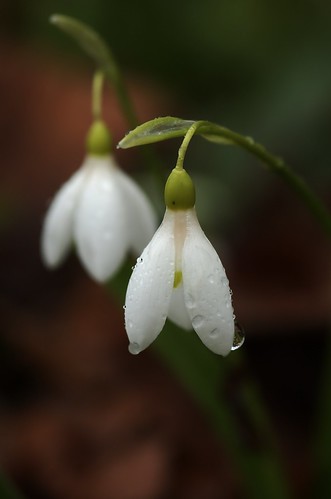
Ik weet het, ik weet het… Ik heb al heel vaak over het sneeuwklokje verteld…
Maar ik klets nu eenmaal het liefst over wat ik op dat ogenblik in mijn tuin vind, en dat is op dit ogenblik niet zo gek veel.
Bloeiende sneeuwklokjes zijn (naast enkele heel vroeg bloeiende krokussen) in onze streken zowat de eerste nectarbron voor vroeg-vliegende insecten, en hebben dus ecologisch zeker hun waarde.
Je moet trouwens een keer aan sneeuwklokjes ruiken…
Nee, buiten valt hun geur meestal nauwelijks op, behalve op een uiterst zachte dag – en je moet er echt wel voor op de grond gaan liggen! Maar als je echt veel klokjes in je tuin hebt, pluk er dan eens een paar, en breng ze naar binnen in een verwarmde kamer… De honinggeur wordt dan al snel merkbaar.
Ondanks hun waarde voor insecten die al vroeg actief zijn, zijn het geen ‘oorspronkelijk-inheemse’ planten, maar neofyten, planten die waarschijnlijk pas sinds een eeuw of vijf in onze streken voorkomen.
Hun originele verspreidingsgebied komt enigszins overeen met ‘de klassieke wereld’: Zuid- en zuid-oost Europa, en klein-Azie. In de middeleeuwen zijn de planten dan in onze contreien ingevoerd, wellicht door monniken. Vervolgens zijn ze langzaamaan verwilderd vanuit kloostertuinen.
In Vlaanderen vind je het plantje nochtans heel zelden in het wild, maar tijdens winterwandelingen in de Ardennen heb ik het vaak zien groeien. Ik heb wel eens horen zeggen dat wanneer je sneeuwklokjes in het wild in grote getale aantreft, dat waarschijnlijk wijst op oude bewoning op die plek.
(Hans Christian Andersen schreef een sprookje over het sneeuwklokje… Een samenvatting)
Snowdrops
I know it, I know it… I have told about snowdrops so many times already – or at least I did so in Dutch.
But I can’t help it that I prefer to talk about what I find in my garden now, and I must admit, that isn’t so much now.
Snowdrops are (apart from some really early blooming crocusses) the first and almost only sources of nectar for insects that are active now already, so they can be considered to have a good ecological value.
(You really should try to smell the fragrance of snowdrops… it’s not so obvious outside, unless the weather is really mild, but when you have lots of snowdrops in your garden, you should bring some of them indoors: in a warm room you’ll suddenly smell their honey!)
Despite of their ecological value, snowdrops aren’t originally native to our region, they are considered neophytes – plants that naturalized here in the last five centuries. Snowdrops originated from what we now consider ’the classical world’: the south and south-east of Europe, and Anatolia, and were brought to Western Europe by monks somewhere in the 16th century.
In Flanders, you seldom find snowdrops in the wild, but I have often discovered them during winter-hikes in the Ardennes. On English blogs, I have seen lots of pictures of snowdrops growing in the wild as well.
I have been told, that when you find wild-growing snowdrops, there has been a dwelling before.
(Hans Christian Andersen wrote a fairy-tale about the snowdrop…)
het zijn ook zulke lieve bloemen 🙂
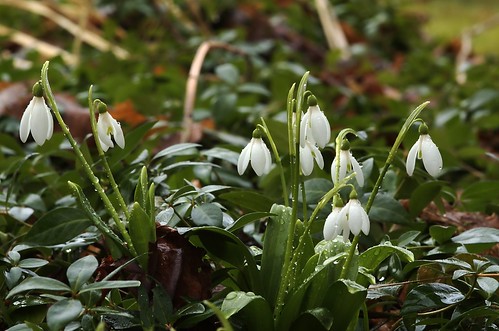
Is dat vinca om da klokjes heen op de 2e foto?
Inderdaad, Vinca minor, kleine maagdenpalm….
ook al is dit al een oud topic, hopelijk volgt er een antwoord… ik hoorde dat vinca minor een stevige bodembedekker is om onkruid weg te houden. Maar lukt het de sneeuwklokjes/krokussen/narcissen/meiklokjes/tulpen om toch ook te bloeien tussen vinca?
Katrien, zoals je op mijn foto ziet, groeien de sneeuwklokjes hier tussen de maagdenpalm. Meiklokjes stonden er ook, maar die heb ik (niet helemaal met succes) weggehaald, omdat die behoorlijk gingen woekeren. Ook krokussen heb ik hier tussen de maagdenpalm staan, en hondstand (Erythronium sp.). Met narcissen zal het volgens mij ook wel lukken.
Tulpen… tja, tulpen zijn al niet zo’n bijzonder goede verwilderbollen. Zelfs onder vrij optimale omstandigheden gaan die vaak toch na een aantal jaren verdwijnen.
Ik zou als sneeuwklokjes tussen maagdenpalm trouwens eerder voor bv Galanthus elwessii, het groot sneeuwklokje, dan voor het gewoon sneeuwklokje kiezen (G. nivalis). Maagdenpalm kan immers wel een vrij dik pakket worden, en het gewoon sneeuwklokje piept daar nauwelijks bovenuit…)
Oh, I don’t mind revisiting snowdrops. I love them, and don’t have any growing here. They have an almost magical quality about them, and your photos of them are just lovely!
.-= laatste blogbericht: Chanterelles =-.
I love the addition of The Snowdrop by Hans Christian Anderson. Definitely snowdrops are my favourite bulbs, for today that is! They’re so dainty, yet so hardy…
I came across this website http://www.snowdropinfo.com/events2010.htm all you Galanthophiles out there may be interested….
I know that Kalmthout is far away for those abroad. In Kalmthout is an arboretum with a world-famous collection of Hamamelis.
Next weekend is the closing weekend of the ‘Hamamelis-festival‘, and that’s combined with a Snowdrops-show. Apart from an exhibition, there are lectures too, but you have to make reservation for the lectures.
Heel teer en breekbaar lijken ze, maar ieder jaar steken ze toch hun kopje weer op om de lente aan te kondigen.
.-= laatste blogbericht: Pipi in de Tipi =-.
Beautiful photos of such exquisite flowers Anne. I don’t think that people many people realise that they are so scented. I grow a few named ones in pots and it has been a great source of enjoyment this week going outside and breathing in their scent 🙂
Anne I really like your snowdrop photos once again. I never realised that they had a scent. We have lots of wild snowdrops growing here in Scotland and its illegal to take them from the wild.
.-= laatste blogbericht: Lemon Stardust and Netty’s Pride Liliums – a cardboard tapestry of blooms. =-.
Je hebt de sneeuwklokjes er weer fraai opgezet. Ik zal beter moeten gaan zoeken, want ben ze nog niet tegen gekomen van het jaar.
.-= laatste blogbericht: Eerste vlinder =-.
Your blog is very beautiful!
Wonderful photos!